Spider suppression requires a mechanical and environmental methodology rather than broad chemical fogging. Spiders groom via tarsal claws rather than oral contact, which renders standard dry residue sprays largely…
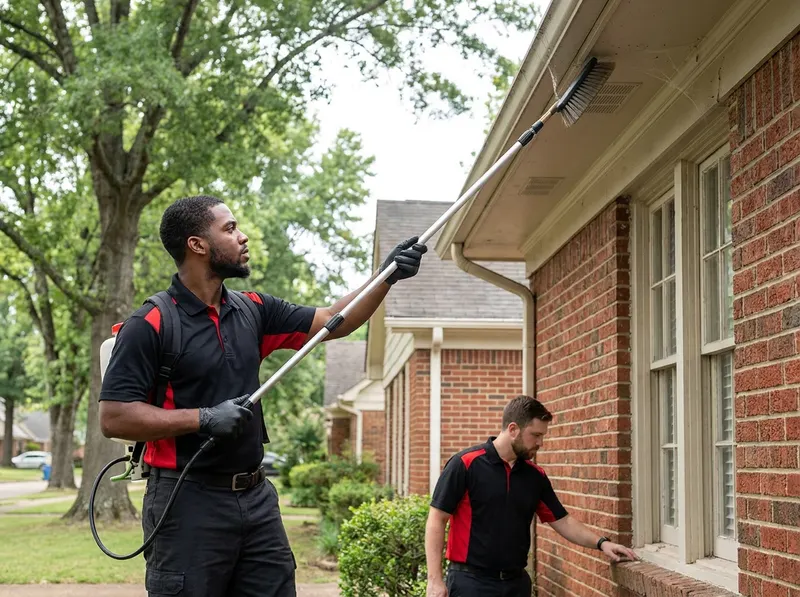
Spider suppression requires a mechanical and environmental methodology rather than broad chemical fogging. Spiders groom via tarsal claws rather than oral contact, which renders standard dry residue sprays largely ineffective against mature specimens. GraniteWing Pest Care executes a dual-action system that combines physical de-webbing, micro-cap residual barriers, and moisture harbor reduction. In river-adjacent zones like Harbor Town and densely vegetated pockets near Shelby Farms Park, exterior lighting arrays attract high volumes of midges, mayflies, and moths, producing an abundant prey matrix for nocturnal hunters. Technicians deploy telescoping vacuum extensions and electrostatic brushes to physically strip egg sacs, structural webbing, and debris from soffits, window assemblies, and under-deck joints up to 24 feet above grade. This mechanical intervention terminates the reproductive cycle immediately by removing clutches that often hold 40 to 300 viable spiderlings per sac.
Residential architecture throughout Central Gardens, Cooper-Young, and Midtown commonly features vented crawlspaces, stone masonry, and tongue-and-groove siding where wood-boring insects and spiders seek refuge. The venomous brown recluse thrives inside these climate-moderated voids, establishing harborage among stacked cellulose, HVAC trunk lines, and wall cavities. Technicians apply non-repellent silica dust formulations into void spaces per EPA pesticide standards, desorbing the protective epicuticle wax layer of arachnids upon contact. Concurrently, our team screens crawlspace access covers and unsealed crawl vents using corrosion-resistant 1/8-inch wire mesh compliant with the Tennessee Department of Environment and Conservation vector control recommendations to deny ingress to predatory species.
Establishing definitive perimeter barriers mitigates inward migration during late-summer humidity surges and early autumn temperature drops across East Memphis, High Point Terrace, and Chickasaw Gardens. Treatments incorporate microencapsulated pyrethroids adhered along foundation bands, band joists, and concrete aprons, calibrated under Clemson Cooperative Extension structural pest guidelines. These water-resistant micro-capsules cling directly to spider abdominal plates and pedipalps as they traverse treated perimeters. Interior protocol utilizes non-toxic, pre-baited sticky monitors positioned inside utility chases, subfloor access hatches, and plumbing cutouts in accordance with UC IPM guidelines to map population density and confirm complete cessation of arachnid movement across the primary living structure.
Every job gets a firm, written price after a free on-site visit.
Tell us about your spider suppression and web abatement job in Memphis and we'll send a clear, written quote, usually the same day.
 GraniteWing Pest Care