Surface spraying of visible ant trails often fails because it triggers buddings, a survival mechanism where satellite queens split off to establish secondary colonies. Granular baiting and non-repellent liquid…
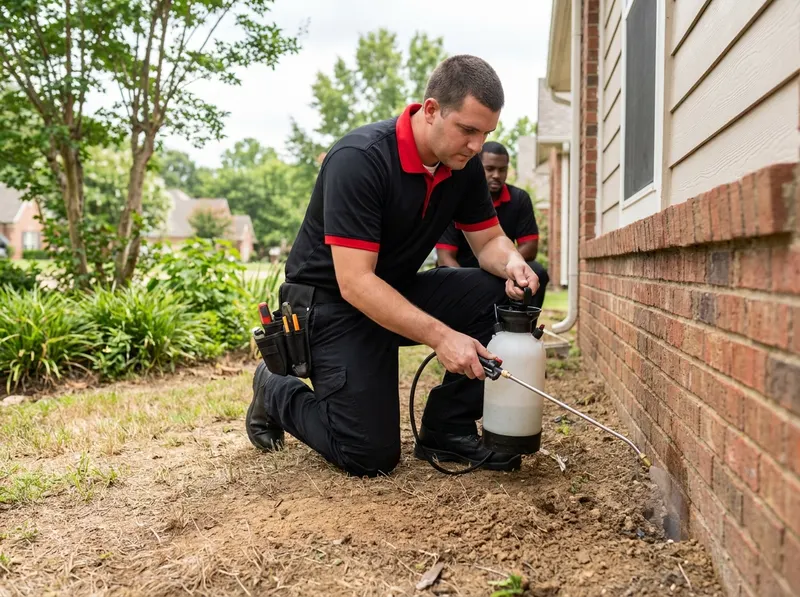
Surface spraying of visible ant trails often fails because it triggers buddings, a survival mechanism where satellite queens split off to establish secondary colonies. Granular baiting and non-repellent liquid transfers deliver systemic agents back to the primary subterranean or wall-void brood chamber. The EPA pesticide safety standards guide the deployment of these non-repellent compounds to ensure food-grade safety near internal pantries while maintaining lethality inside the central nest. If an infestation is limited to a single kitchen foraging path, micro-targeted gel matrices resolve the issue without broad disruptions; if carpenter ants have breached soft, moisture-laden framing around crawlspaces or window sills, the protocol requires void injection and perimeter excavation. Property owners face a trade-off: fast-knockdown pyrethroid sprays offer immediate visual relief on a porch but leave subterranean queens intact to repopulate within three weeks, whereas slower metabolic inhibitors require five to ten days to circulate fully through trophallaxis but secure permanent nest extinction.
Memphis microclimates exacerbate nesting behavior across distinct architectural zones. In Cooper-Young and Central Gardens, historic tongue-and-groove framing and raised pier-and-beam crawlspaces frequently retain humidity, providing ideal nesting substrate for acrobat and carpenter ants. Low-lying riverfront properties along Harbor Town encounter subterranean Argentine ant supercolonies that migrate up foundations following seasonal flood shifts along the Mississippi River. Technicians operating under Tennessee Department of Agriculture regulatory standards analyze these structural vulnerabilities during on-site inspections. High Point Terrace and Midtown residences with dense oak canopies experience canopy bridging, where carpenter ants access cedar shake roofs and fascia boards directly from overhanging limbs. In East Memphis and Chickasaw Gardens, expansive turf lawns over heavy alluvial clay soils regularly harbor red imported fire ant mounds, governed by the federal quarantine framework outlined by the USDA Animal and Plant Health Inspection Service.
Subterranean moisture dynamics dictate structural risk. According to the National Weather Service climate data, Memphis experiences an average annual precipitation exceeding 53 inches, driving saturated soils in neighborhoods like Binghampton, Berclair, and Whitehaven. Water accumulation against masonry foundations forces subterranean species indoors through expansion joints, plumbing penetrations, and weep holes. GraniteWing Pest Care addresses these pressure points using structural perimeter barriers aligned with HUD housing quality standards. Biological surveillance protocols established by the Entomological Society of America demonstrate that bait matrix acceptance depends heavily on seasonal carbohydrate versus protein demands. By matching the nutritional carrier to the seasonal cycle of the colony, active ingredients bypass worker defense thresholds, reaching the central queen. For crawlspaces showing elevated moisture readings, structural guidelines from the Building Science Corporation emphasize localized ground-cover mitigation to prevent recurring nesting sites beneath subfloors, while technical insights from the Pest Control Technology technical index and university field guidance from the University of Tennessee Agricultural Extension inform continuous monitoring intervals across every sector of the property.
Every job gets a firm, written price after a free on-site visit.
Tell us about your ant colony elimination job in Memphis and we'll send a clear, written quote, usually the same day.
 GraniteWing Pest Care